
Riverside County Court serves as the main trial-level court for one of California’s most populated regions. It operates under the state judicial framework and manages a wide range of legal proceedings at the county level. The court handles civil, criminal, family, probate, and traffic cases through an organized court structure. As part of the Riverside court system, it applies California law within local jurisdiction. This role places the court at the center of day-to-day justice across Riverside County.
Riverside County Court functions as a key county judicial authority within the California trial courts. It provides a formal setting where cases move from filing to resolution through hearings and trials. Judges, clerks, and court staff work together to keep case flow steady and records accurate. The court system supports consistent procedures across multiple courthouse locations. Through this structure, the court helps maintain lawful order and fair case handling throughout Riverside County.

How to Search Riverside County Court Records Online
Searching Riverside County Court records online can be done through the official court Public Access portal. A user can run a public case search by case number or party name and view online court records for civil, criminal, family, probate, and other case types.
The official portal to begin this search is the Riverside County Superior Court Public Access system:
https://www.riverside.courts.ca.gov/online-services/search-court-records-public-access
Open the Court’s Public Access Search Page
The first action is to open the Superior Court of California, County of Riverside Public Access page. This is the main tool for searching Riverside County Court records online. Users should enter the URL into their browser exactly as shown:
https://www.riverside.courts.ca.gov/online-services/search-court-records-public-access
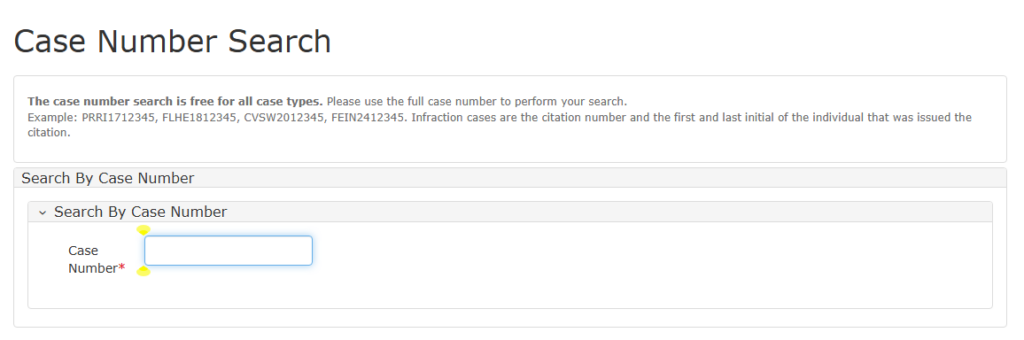
Once the page loads, the user sees the search form that allows searches by case number or party name. The search system displays public case data including filing date, case type, court division, and status. Some older cases may not appear because the court removes (purges) records after many years per California law.
Choose Your Search Input
On the search page, the user must choose one of these:
- Case Number — If the user already has a case number, entering this number usually returns results immediately. This is the most precise way to find a record.
- Party Name — Enter the first and last name of one party in the case (for example, “John Smith”). The system will return matches that include those terms.
Submit the Search and Review Results
After entering the case number or party name, the user clicks the Search button. The system then displays:
- Case number
- Case type (civil, criminal, family, probate, traffic)
- Filing date
- Court location (division/courthouse)
- Case status and hearing dates
Understand What You Can and Cannot See Online
- Most basic case metadata and status information is available through the portal. Detailed documents (like motions or transcripts) may not be fully accessible online for all cases.
- Records involving minors, sealed files, or certain sensitive proceedings (for example, some family law details) remain restricted and require special authorization or in‑person review at the courthouse.
- If a public record is not available online, users may submit a records request through the court or visit the courthouse in person to view records using public terminals.
Request Certified Copies or Official Documents
For copies that must be certified or mailed, the user can submit a formal request either online or at the court clerk’s office. Fees typically apply, including:
- Search fees if the clerk performs the search
- Copy and certification fees (often per page or per document)
- Postage or retrieval fees for mailed documents
What Is the Riverside County Superior Court?
The Riverside County Superior Court serves as the county’s general trial court with broad judicial authority. It handles civil, criminal, family, probate, traffic, and juvenile matters through elected judges and court commissioners.
The Riverside County Superior Court stands as the main trial-level court for Riverside County, California. It operates under the California Constitution and applies state law at the local level. The court hears cases from filing through final rulings, then sends qualifying appeals to higher courts. Its role centers on fair hearings, lawful decisions, and open proceedings that follow state rules.
Role and Judicial Authority of the Court
The Riverside County Superior Court acts as a general trial court, which means it hears a wide range of case types. Its judicial authority allows judges to rule on facts, interpret statutes, issue orders, and enter judgments.
This authority covers both jury and bench trials, so cases may involve jurors or judges alone.
Common case categories include:
- Criminal cases, such as misdemeanors and felonies
- Civil disputes, including contracts and personal injury
- Family law matters, like divorce, custody, and support
- Probate cases, covering estates, trusts, and guardianships
- Juvenile proceedings, focused on youth welfare and conduct
Judges, Court Commissioners, and Court Structure
The court’s leadership includes elected judges chosen by county voters. Each judge serves a fixed term and must meet state qualification standards. These judges preside over trials, rule on motions, and issue final decisions.
Alongside judges, court commissioners manage many daily proceedings. Commissioners handle assignments like traffic matters, preliminary hearings, and family law calendars.
Key structural features include:
- Multiple courthouse locations across Riverside County
- Separate divisions for criminal, civil, family, probate, and juvenile cases
- Public hearings held in open courtrooms, except where law requires privacy
Riverside County Clerk of Court & County Clerk Roles
The Clerk of Court Riverside County manages court records, filings, and daily courtroom administration. The County Clerk Recorder handles official public documents and vital records for county residents.
The Clerk of Court Riverside County plays a central role in court operations. This office supports judges, court staff, and the public by keeping case information accurate and organized. Every filing, ruling, and hearing record passes through the clerk’s system. Clear record handling helps cases move forward without delays.
Clerk of Court Riverside County Responsibilities
The Clerk of Court Riverside County focuses on court record management and courtroom support. Staff members receive filings, process case updates, and maintain official case histories. They keep both paper and digital records aligned with state rules.
For example, criminal dockets, civil filings, and family law case entries remain indexed through clerk-managed systems.
Core duties include:
- Filing and indexing court documents
- Maintaining calendars and hearing records
- Issuing certified court copies
- Recording judgments, orders, and verdicts
County Clerk Recorder and Public Document Services
The county clerk recorder operates as a separate county office with a different focus. This role manages public document services that affect daily life beyond the courtroom.
Residents rely on this office for official records tied to identity, property, and civic matters.
Common services include:
- Recording property deeds and liens
- Issuing birth, death, and marriage certificates
- Registering business names and filings
- Maintaining election and voter records
Public Access
Riverside County Court Records are official files created during court proceedings across the county. These records support legal transparency by showing case activity, filings, rulings, and outcomes.
Riverside County Court Records document how cases move through the court system. Each record reflects actions taken by judges, clerks, and parties involved in a case. This documentation builds trust in the justice process by keeping court activity open for public review.
Records may exist in digital or paper form, depending on case type and filing date.
What Are Public Court Records?
Public court records include non-restricted case files created by the court. These records often cover civil, criminal, family, probate, and traffic matters. Some files remain limited by law, such as sealed cases or sensitive juvenile matters.
Most public files show key case details, so readers can track progress and outcomes.
Common court documentation includes:
- Case summaries and party names
- Filing dates and hearing schedules
- Motions, orders, and judgments
- Verdicts and sentencing entries
Legal Transparency and Record Availability
Legal transparency depends on clear and accurate court documentation. Riverside County courts publish records to support public trust and lawful review. Open records help residents, journalists, and legal professionals review court actions without direct courtroom attendance.
Record availability varies by case status, document type, and privacy rules.
Limits may apply to:
- Sealed or confidential filings
- Juvenile case materials
- Certain family law records
- Active investigations
Types of Cases Handled by Riverside County Court
Riverside County Court hears many case types across separate divisions. Each division focuses on a specific area of law to keep cases organized and hearings efficient.
The court system in Riverside County separates cases by subject matter. This structure helps judges, court staff, and the public follow clear procedures. Each division applies state law within its assigned scope. Below is a clear breakdown of the main case types handled by the court.
Civil Court
The Riverside County civil court resolves disputes between parties seeking money damages or court orders. These cases do not involve criminal charges. Most filings relate to contracts, property, or personal rights.
Judges review evidence, hear arguments, and issue binding rulings.
Common civil case types include:
- Contract disputes
- Personal injury claims
- Property and landlord-tenant cases
- Debt collection matters
Criminal Court
The Riverside County criminal court handles cases where the state alleges violations of criminal law. These matters involve public safety and legal accountability.
Judges oversee arraignments, motions, trials, and sentencing hearings.
Criminal cases fall into two main groups:
- Misdemeanors, such as minor theft or traffic-related offenses
- Felonies, including serious charges like assault or burglary
Family Court
The Riverside County family court addresses legal issues tied to household relationships. These cases often involve emotional and financial concerns.
Judges focus on fair outcomes that follow state statutes and court rules.
Family court matters include:
- Divorce and legal separation
- Child custody and visitation
- Child and spousal support
- Domestic violence restraining orders
Probate Court
The Riverside County probate court manages cases involving estates and legal care. These proceedings affect property distribution and personal welfare.
Judges confirm wills, appoint fiduciaries, and review financial reports.
Probate court handles:
- Estate administration after death
- Trust disputes and oversight
- Guardianships for minors
- Conservatorships for adults
Juvenile Court
The Riverside County juvenile court serves minors involved in delinquency or dependency matters. This division applies separate procedures from adult court.
Judges focus on supervision, care, and rehabilitation.
Juvenile court cases include:
- Delinquency matters tied to alleged offenses
- Dependency cases involving child welfare
Specialty Courts
Riverside County operates specialty courts for targeted case needs. These courts focus on treatment and supervision instead of traditional penalties.
Judges, counselors, and service providers work together through structured programs.
Key specialty courts include:
- Riverside County veterans court, serving former military members
- Riverside County drug court, addressing substance-related offenses
Federal Court vs Riverside County Court
The United States District Court Riverside handles federal cases under national law. Riverside County Court manages state-level matters under California law.
The United States District Court Riverside operates as part of the Central District of California. This federal court hears cases tied to federal statutes, the U.S. Constitution, and disputes that cross state lines. Judges receive lifetime appointments and follow federal procedures. Court locations serve multiple counties, including Riverside County. By comparison, Riverside County Court works under California’s judicial system. It serves as a general trial court for local and state matters. Judges gain office through county elections and handle a wide range of cases that affect daily life in the community.
Jurisdiction and Case Types
Federal courts focus on limited subject areas defined by federal law. Common case categories include:
- Federal criminal charges
- Civil rights claims under federal statutes
- Bankruptcy matters
- Disputes between parties from different states
Court Structure and Procedures
The Central District of California follows uniform federal rules across all its locations. Federal trials often involve longer timelines and formal procedures. Juries may include residents from a broader geographic area.
State court procedures follow California rules and local practices. Calendars move faster in many divisions, especially for traffic and small claims matters.
State vs Federal Courts
A clear distinction exists in authority and scope. Federal courts apply national law, and state courts apply California law. Appeals from Riverside County Court move through the California appellate system. Appeals from the United States District Court Riverside proceed to the Ninth Circuit Court of Appeals. Both courts serve vital roles. One enforces federal law across regions, and the other resolves local legal matters within Riverside County.
Are Riverside County Court Records Public?
Are Riverside County Court records public? Yes, many records are open for public review under California law. Certain files remain restricted to protect privacy, safety, and legal rights.
Riverside County Court records follow state rules that support openness in judicial proceedings. These rules reflect public access laws that promote accountability and trust in the court system. Many case files, dockets, and rulings remain available for public viewing through official court channels. This openness allows residents to see how cases move forward and how decisions take shape.
Public Records Available for Review
Most court files created during civil and criminal proceedings qualify as public. These records show case progress and final outcomes.
Examples of public court records include:
- Civil case summaries and judgments
- Criminal case filings and sentencing entries
- Traffic and misdemeanor case dockets
- Probate case listings and orders
Sealed Records and Confidential Cases
Not all court records remain open. Sealed records stay closed by court order or statute. Judges may seal files to protect sensitive information or lawful interests. Confidential cases follow strict limits set by state law.
Restricted case types often include:
- Juvenile delinquency and dependency matters
- Adoption proceedings
- Certain family law filings
- Mental health and conservatorship reports
How Public Access Laws Shape Record Availability
California public access laws balance openness with privacy. Courts release records that serve public interest while limiting material that could cause harm. Record status may change over time. A case once sealed may later become open after court review.
History of the Riverside County Court
The history of Riverside County Court shows how local justice evolved with population growth and legal demand. From early courtrooms to modern justice centers, the system reflects long-term judicial development in California.
The history of Riverside County Court begins after Riverside County formed in 1893. Early court operations followed California law and relied on limited space, handwritten filings, and small judicial staff. Judges handled civil and criminal matters in shared government buildings, which matched the county’s early structure. This early judicial system focused on basic dispute resolution and public order.
Key Milestones in Court Establishment
As filings increased, the court system gained structure and stability. These early developments followed patterns seen across California county courts history.
Major early milestones include:
- Formation of county-level courts after 1893
- Appointment and election of local judges
- Use of paper dockets and ledger-based case tracking
- Growing land, contract, and criminal filings
Significance of the 1903 Riverside Historic Courthouse
The Riverside Historic Courthouse, completed in 1903, became a lasting symbol of justice in the county. Its construction marked a shift from temporary courtrooms to a permanent judicial center.
For decades, judges held trials and hearings in this building, shaping local legal outcomes and public confidence.
Expansion of Justice Centers
As Riverside County expanded, the court system followed. New locations reduced travel distance and improved scheduling across divisions.
Court expansion included:
- Additional courthouses across the county
- Separate divisions for civil, criminal, family, probate, and juvenile cases
- Improved courtroom capacity for rising caseloads
Court Modernization and Record Systems
Modern courts replaced paper-heavy processes with digital systems. Court modernization improved efficiency and long-term record handling.
Key modernization changes include:
- Electronic case management systems
- Digital calendars and filings
- Improved storage and record accuracy
Riverside County Court Locations & Justice Centers
Riverside County Court locations operate across the county to support hearings, filings, and court operations. Each justice center serves assigned cities and case types through dedicated court facilities.
Riverside County covers a large geographic area, so multiple courthouses ensure accessible services for residents. Justice centers act as local hubs where judges, clerks, and court staff manage daily proceedings efficiently, reducing travel for parties involved in court matters.
Purpose of Justice Centers
Justice centers distribute cases based on geography and division workload. Each courthouse handles specific case types tied to its service area.
Court facilities commonly support:
- Civil and small claims hearings
- Criminal arraignments and trials
- Family law calendars
- Probate and limited juvenile matters
Riverside County Court Locations, Addresses & Office Hours
| Courthouse | Address | Office Hours |
|---|---|---|
| Riverside Hall of Justice | 4050 Main Street, Riverside, CA 92501 | Mon–Fri: 8:00 AM – 4:00 PM |
| Riverside Family Law Courthouse | 4175 Main Street, Riverside, CA 92501 | Mon–Fri: 8:00 AM – 4:00 PM |
| Moreno Valley Courthouse | 13850 Heacock Street, Moreno Valley, CA 92553 | Mon–Fri: 8:00 AM – 4:00 PM |
| Palm Springs Courthouse | 3255 East Tahquitz Canyon Way, Palm Springs, CA 92262 | Mon–Fri: 8:00 AM – 4:00 PM |
| Banning Justice Center | 311 East Ramsey Street, Banning, CA 92220 | Mon–Fri: 8:00 AM – 4:00 PM |
| Murrieta Southwest Justice Center | 30755-D Auld Road, Murrieta, CA 92563 | Mon–Fri: 8:00 AM – 4:00 PM |
| Hemet Courthouse | 880 North State Street, Hemet, CA 92543 | Mon–Fri: 8:00 AM – 4:00 PM |
| Indio Larson Justice Center | 46-200 Oasis Street, Indio, CA 92201 | Mon–Fri: 8:00 AM – 4:00 PM |
| Blythe Courthouse | 265 North Broadway, Blythe, CA 92225 | Mon–Fri: 8:00 AM – 4:00 PM |
Frequently Asked Questions
Riverside County residents often have questions about court records, public access, and related procedures. Understanding these details can save time and help users interact with the court system effectively.
How long do court records stay available?
Riverside County court records generally remain accessible for many years after a case concludes. Civil, criminal, and family law files are archived and indexed to allow retrieval over time. Digital record systems make it easier to search for recent cases, while older paper files are maintained in courthouse archives. However, certain cases, such as sealed or confidential records, remain inaccessible to the public indefinitely to protect privacy or legal interests.
Can I access criminal records online?
Many criminal case records are available through Riverside County’s official online portals. Users can search using the case number, the names of parties involved, or citation numbers. Public online access typically includes docket information, filings, hearing dates, and dispositions. Some records may be restricted due to privacy regulations or ongoing investigations, so access is not guaranteed in every case.
Are juvenile records public?
Juvenile court records are generally confidential under California law. These records include matters of delinquency, dependency, and child welfare. Access is limited to authorized parties such as parents, legal guardians, attorneys, or designated agencies. Confidentiality helps protect minors while still allowing proper judicial oversight and legal proceedings.
What if I can’t find my case?
If a case does not appear in public search tools, it may be sealed by court order, filed under a confidential designation, or incorrectly indexed due to errors in the case number or party name. When this occurs, contacting the appropriate courthouse clerk’s office is recommended. Clerks can verify case details, clarify the reason for restricted access, and provide guidance on obtaining authorized records.
Is there a fee for copies?
Yes, Riverside County charges fees for certified copies, case documents, or transcripts. The exact fee depends on the type of document and the number of pages. Payments are typically accepted in person at the courthouse or through authorized online systems. Fee schedules are posted on the courthouse websites and available at public counters.
Can I request court records by mail or email?
Many courthouses accept written requests for records. Users must provide detailed information about the case, including case numbers, party names, and the type of record requested. Fees may apply, and processing times vary depending on the volume of requests and whether the records are in digital or paper format.
Are traffic violation records public?
Traffic case records are generally available to the public once fines or penalties have been processed. Online portals may include ticket filings, scheduled hearing dates, and case resolutions. Exceptions apply for juvenile drivers or cases with special confidentiality requirements.